Sunday, March 30, 2014

Teamwork Multiplayer

I just recently read a article and I found a good quote that I would like to share. "Gaming didn't eliminate social interaction, it supplemented it." There is definitely many truth to this statement as modern day gaming usually involve some form of social interaction.

Let's bank that thought for a few seconds. If I ask you to generate an image of a "Gamer" in your mind, what do you think that will look like? Perhaps an image of a person (alone) sitting in front of a computer or TV, constantly starring at the screen and seemingly motionless (except may be the hands on the controller). The only recorded interaction is mostly be the player reacting to things that's happening on screen.

Regrettably, the image may still be relevant if our focus is on single-player oriented gaming experience only. However, more and more video games are developed partially, if not mainly, with the focus on the multiplayer elements. Multiplayer, a game type that involve more than one person, basically mean adding the "social" interaction into video gaming. Multiplayer are meant for players to interact with each other either competitively or cooperatively. The interaction can be as simple as typing into the in-game chat system to having a full conversation using mic-headphones accessories.
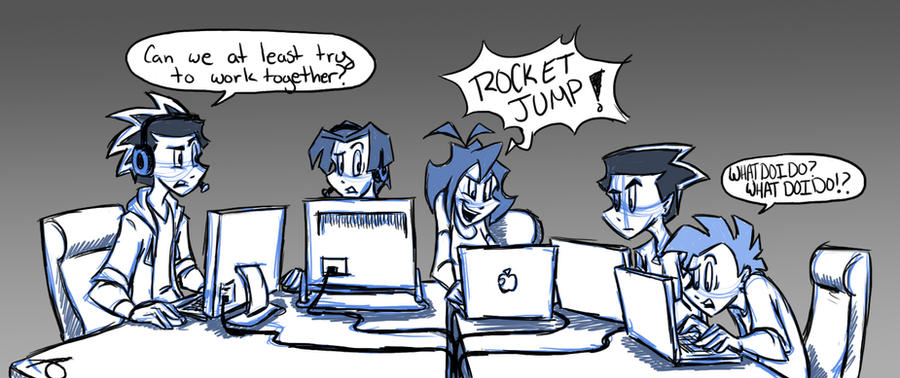

I also notice a trend had develop within the "Multiplayer" realm. A shift from the traditional "Free-for-All" (me vs. the world) to more of a focus on "Team Battle" (team vs team). Examples can be found in some of the hottest titles in the market; the multiplayer game type are usually team oriented, such as:
  • Call of Duty: Ghosts - Team Deathmatch, Extinction
  • Titanfall - Attrition, Hardpoint Domination
  • Assassin's Creed IV: Black Flag - Wolf Pack DLC
  • Match Making in sport games such as FIFA 14, Madden NFL 25, NHL 14
  • Apps such as Clash of Clans, Candy Crush Saga

*Warning, video game (multiplayer) supplements social interaction, and it should not be interpreted as the "only" interaction.

Here is the [link] to the article.

Friday, March 28, 2014

Slight Update...(and I'm back!)


Well, I just notice that I had not been writing anything to this block for almost 3 weeks now. All I can say is that life has been busy and finding time for this blog was difficult. Anyway, I'm back now and I should have new post(s) coming up very shortly. I may make a few changes here and there to keep it refreshing.

P.S. I finally bite the bullet and bought a XboxOne, that totally didn't contribute on my "proper" time management at all. (FYI, Gamertag: Noface2give)


Sunday, March 2, 2014

Reduce Craving with Video Games


Has the following scenario ever happened to you? You are so focus on doing one thing that you’ve forgotten a meal, or at the least delayed it for a couple of hours. Chances are your answer is “yes”, and the reason for doing that may vary. Some of the reasons may be very important to us; some other reasons may just be silly all together. An obvious example for the gamers, you’ve might have skipped a meal (or two) simply because you tried to get to the next checkpoint so the game will save your progress. Unfortunately, I’m not here to justify such behavior because doesn’t matter how you look at it, skipping a meal is bad for you. However, I do believe this is only one extreme and there are middle ground that gaming can be beneficial in terms of reduce craving.

To (really) generalize that thought: when a person is focus on doing one thing, it may take some of the craving for another away from our system. An article posted on The Atlantic called “Playing Tetris Can Reduce Urges to Eat, Smoke, Drink” by Julie Beck reinforce that thought. The article summarized a study that shows playing Tetris help reduce craving by 24 percent.

Perhaps my favorite part of the article is this, “Strange as it may seem, Tetris could actually be a helpful tool for those trying to quit smoking, or just avoid indulging in an unhealthy snack.” It goes to show the possibility of Tetris (or other games) can be beneficial on certain aspect of life.


Here is the [link] to Julie’s article.

Sunday, February 23, 2014

Addictive Games


From the Angry Bird 3-stars mania, to Candy Crush Saga obsession, and then to the most recent Flappy Bird infinite sensation (and its clones), we can conclude that addictive games have their place in our heart; or at least in our smartphone. This pattern is obvious, addictive games are here to stay and will be continually appears in different form.


This actually sparked my curiosity, so I started to scout for articles related to addictive game. And I found this blog by NICK BILTON, Disruptions: Using Addictive Games to Build Better Brains, listed on the The New York Times. Apparently, there are researches and studies done on the effect of addictive games. Although the article did not provide details on how and what benefits do addictive games have on us, but at least it indicated video games does have the potential to “make our minds stronger, faster and healthier.” I guess we just need to stay tuned and see what constructive developments spur out from these researches.

Here is the [link] to Nick’s article.

Monday, February 17, 2014

Brain Training and Video Game


There are many categories of game in the market; "Casual", "Role-playing", "Strategy", just to name a few. When it comes to a video game pick with beneficial attributes, "Puzzle" type is probably the category of choice for most. This is because “Puzzle” tends to convey an image of brain-training, which is most certainly and proven to be true. A great example is Lumosity.com, a collection of neuroscience exercises that design to look just like “Puzzle” games.

With that being said, it is easy to overlook the others. Each type of video game provides different constructive element to the gamer, some of which are hard to notice. A recent research from Oxford University (summarized by Gamespot.com) mentioned that "Action" type games may help manage dyslexia, a condition of learning disability affecting reading, writing and spelling. [Here is the link to the Gamespot article by Eddie Makuch]

"Action" game requires the person in front of the screen to shift attention quickly between objects. This type of games consists of hundreds and thousands of visual and audio cues in order to keep the game engaging and refreshing. Simply put, it requires player to react quickly as sounds emerge and things pop up on the screen. Think about “Super Mario Bros.” The main point is to not only focus on Mario himself, but also other characters and objects appear from the right side of the screen; music and other audio clips also play the role of setting the tone and stimulation.


Sunday, February 9, 2014

Parenting and Video Game

I went on Flipboard (app) today with the intention of catching the latest update on the removal of the highly addictive game “Flappy Bird” from the App Store. But it was another post that captures my attention, an article published on Forbe titled “Violent Video Games Can Turn Kids Into Progressive Intellectuals” by Jordan Shapiro [link]. This article does not necessary point out the positive of video game directly, but it did challenge the reader to think differently about video game; it is not all bad.

Video game, which can be interpret as a tool of interactive story-telling, are no different than other tools in our daily lives; tools that can be both beneficial and harmful at the same time. On one hand it provides the purpose of entertainment/stress relieve, but on another it also can be seen as a gateway of immoral behaviors. We are merely looking at both sides of the same coin.

Perhaps my favorite statement from Jordon’s article is: “It is not the violence of video games that creates morally immature individuals, but lack of supervision, education, and good parenting." Computer programs, televisions, and tablets can’t be trusted on their own, parents need to teach kids how to use them.”

Cartoon from

Monday, February 3, 2014

In the Beginning...

I always want to do something related to the video game industry, but I never knew where to start. I've tried to write video game reviews only to realize many are doing the same thing. I've tried to do podcast and live stream with other gamers but with no success.

However, just recently I came across a video by AsapSCIENCE and it sparks this idea; start a blog and collect as many resources on the positive side of video game as possible. I'm not sure how far will this lead me down the rabbit hole, but there is no where else to go but forward.

So my journey begins...

Here is the very first resource that I came across and it is also a tribute to AsapSCIENCE. I hope this spark something in your mind as well.


If the above video did not convince you to continue this journey with me, maybe this "bonus" fact will. The Entertainment Software Association stated that "58% of Americans play video games" in their "2013 Essential Facts" publication. That simply means, every other person that you came across is a potential gamer.